What a Falling Market Reminded Me About Losing a Job
Maybe this year has cost you something too. A pension that looks thinner than it did in spring, an investment that has not come back, the quiet sense that the ground is less solid than it was.
I have been sitting with that feeling myself these past few weeks. And somewhere in it, I recognised something I have seen a hundred times before, on the faces of people who have just been told their role is gone.
The market is a strange teacher. I know the theory as well as anyone. Markets fall and markets recover, the drop on the screen is only a loss on paper until you sell, the sensible thing is to hold your nerve and do nothing. I have said all of it to other people, calmly, more than once. None of it stopped the small, cold drop in my stomach when I opened the account and saw the number in red.
That gap, between what you know and what you feel, is the whole thing. And it is a small, safe rehearsal for a loss that is neither.
The body reacts before the mind catches up
There is a finding in behavioural economics that has held up for fifty years. Kahneman and Tversky called it loss aversion, the centre of their work on prospect theory, and it says something simple and stubborn about us. A loss feels roughly twice as powerful as an equivalent gain. Win a thousand and you are pleased for an afternoon. Lose a thousand and you carry it for a week. It is not a flaw in a few anxious people. It is how most of us are built.
Now think about what that means for a senior leader who has just lost a role.
The promotion that took them there was a gain, and they enjoyed it for a season before it quietly became the new normal. The loss of the title lands with twice the force and does not fade on the same timetable. The salary is part of it, of course, and for many people the salary is the sharp, practical worry that keeps them up at night. But the earnings are rarely the whole of it. Wrapped up in the same loss is status, routine, identity, the answer you give at dinner when someone asks what you do. All of it moves at once, and the body registers it long before the mind has any useful plan.
A wobble in your savings gives you a shadow of that feeling. The people I work with feel the full weight of it, and they feel it without warning.
The interval is the hardest part
Sitting through a market drop teaches you something that still surprises me after years of it. The pain is not really the fall. The pain is the interval. The not knowing how long it lasts, whether this is the bottom or the halfway point, how much worse it gets before it turns.
A career transition is mostly interval. The exit conversation is one bad hour. The months that follow are the hard part, the applications that go quiet, the roles that almost happen and then do not, the slow question of whether the market wants you at all. Most of the work I do with people in outplacement is work on the interval. Steadying the nerve. Keeping the routine. Making sure the story a person tells themselves in the waiting does not curdle into the wrong conclusion.
And here is where the comparison breaks, which is the part worth sitting with.
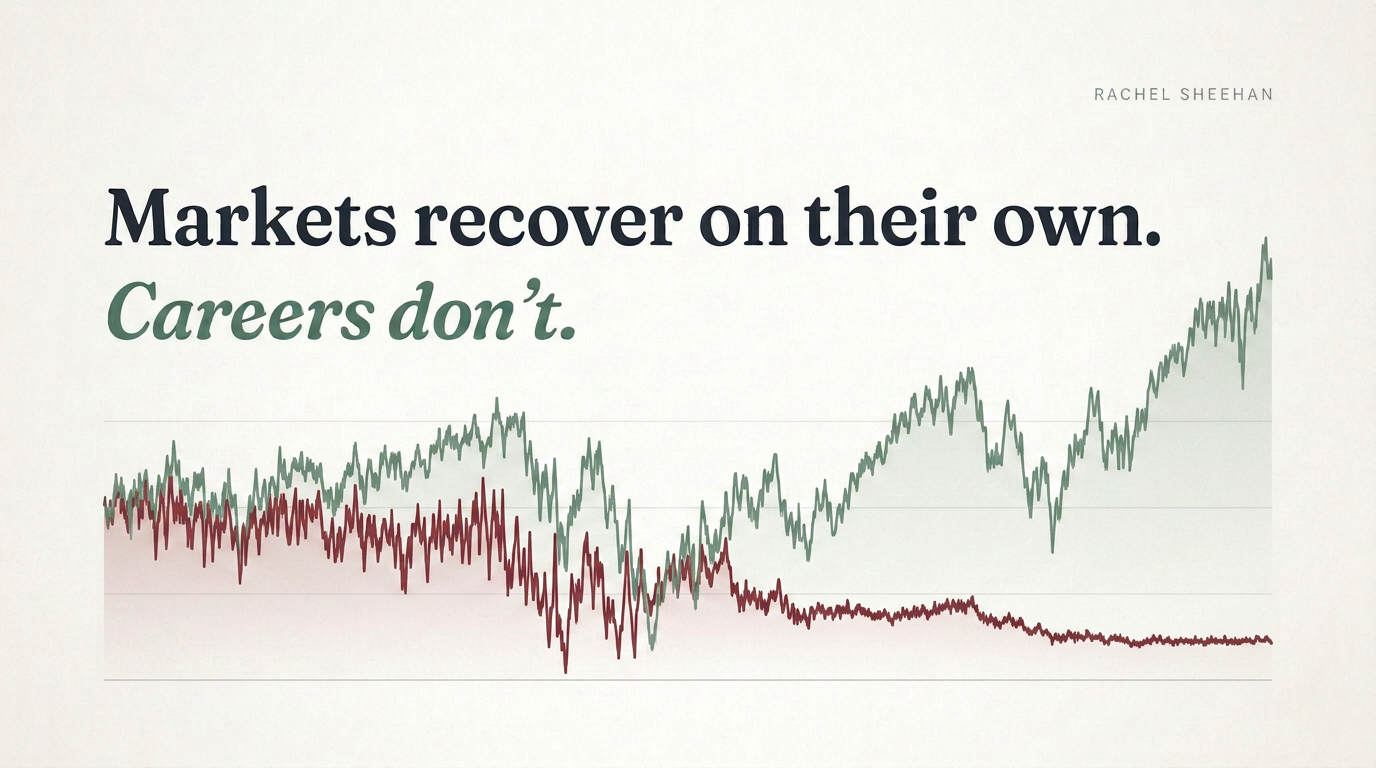
A market recovers on its own. It asks nothing of you but patience. You can close the laptop, go for a walk, and the index will do its work without your help. A career does not come back while you wait. It comes back through what you do in the interval, the conversations you have, the narrative you rebuild, the people you let in. Passive holding is the right move for a portfolio. It is the wrong move for a professional life. The waiting that heals your savings will quietly hollow out your job search.
Concentration is the real risk
Every investor learns the same first lesson. Do not put everything in one stock. A portfolio built on a single company is fine right up until the day it is not, and then it is a catastrophe rather than a setback.
We understand this instinctively about money and forget it entirely about ourselves.
A great many capable people have their whole sense of worth invested in one position. One title, one employer, one answer to the question of who they are. It holds beautifully until the day the position closes, and then the loss is not partial, it is total, because there was nothing else carrying any of the weight. The people I have watched come through job loss in the best shape are not the ones with the deepest savings, though that helps. They are the ones whose sense of themselves was diversified. Work mattered to them, but it was never the only thing holding them up.
That is not a soft observation. It is the most practical form of resilience I know, and it is worth building before you need it, not after.
If the ground feels less steady than it did
The red on your screen will most likely be green again in time. That is the mercy of markets, and it is a mercy that careers do not extend for free.
But if this year has unsettled you, it is worth letting it do one useful thing. Notice how quickly the feeling arrived, ahead of any plan. Notice how a number on a screen reached something that had nothing to do with money. That is a small, borrowed taste of what a real professional loss does to a person, and knowing it in advance is worth more than any reassurance after the fact.
If you are steadying someone through that right now, or quietly wondering how steady your own ground is, be gentle about the distance between what you know and what you feel. Knowing that it passes does not stop it hurting. The task is never to feel nothing. The task is to keep moving while you feel it, and to have built a life wide enough that no single loss can take all of you at once.
If this resonated with you, I'd love to continue the conversation.
Get in Touch