Resilience: More Than Bouncing Back
I was listening to a podcast recently and the host made a distinction I hadn't heard before. She talked about two completely different definitions of resilience.
The first is the engineering definition: the capacity of a material to absorb stress and return to its original form. Think of steel bending under pressure and springing back to exactly where it was. The second is the psychological definition: the ability to adapt and recover in the face of adversity. The engineering version assumes you go back to where you started. The psychological version doesn't. In fact, the research suggests something more interesting than simply coming back different. People who move through real adversity often come out stronger, clearer, and more capable than they were before it. Not restored. Better.
That distinction stayed with me, because it perfectly describes something I witnessed with one of my clients.
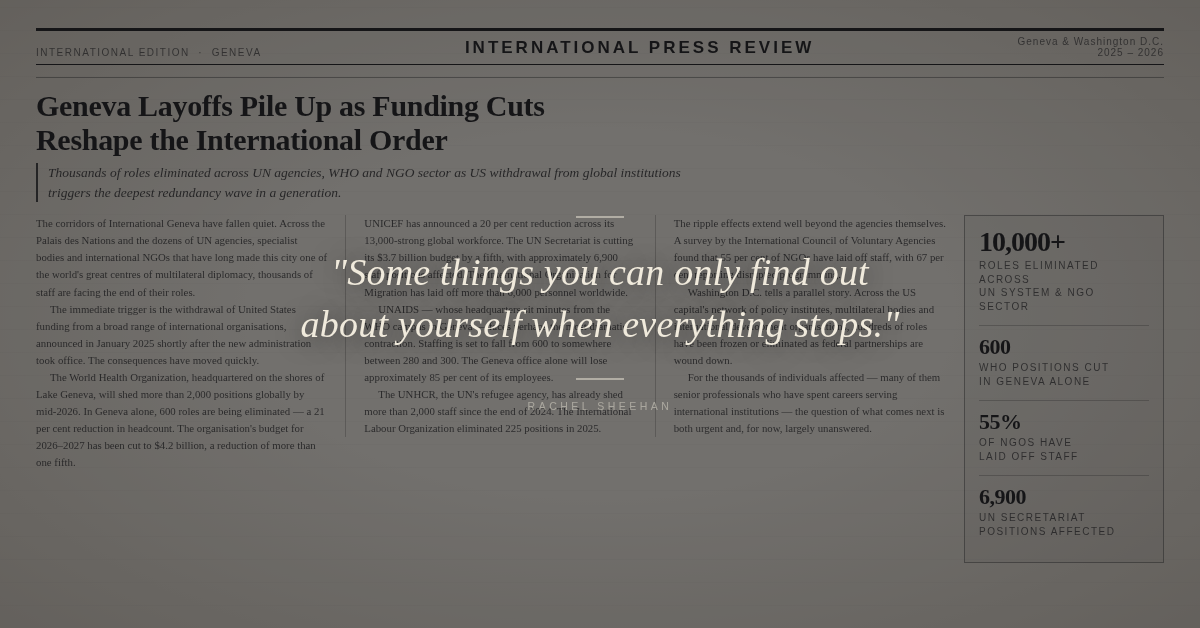
He had built his career over fifteen years inside international organisations in Geneva. A career defined by purpose, by contribution, by the kind of work that feels like it matters. Then came the wave of funding cuts that swept through Geneva's international community, and he found himself, along with many talented colleagues, suddenly out of a job.
If you've ever experienced that kind of redundancy, you'll know the particular shock of it. It isn't just the loss of income. It's the loss of structure, of identity, of the professional world you'd inhabited for over a decade. He was facing all of that, plus a job market that felt foreign after years inside one ecosystem. Fear was there. Overwhelm was there. So was the quiet, uncomfortable question that many of his colleagues were also sitting with: what now?
We started by building the foundations. That meant more than documents. It meant working out his story, his accomplishments across those fifteen years, what he stood for, and what he wanted to walk towards rather than just away from. The CV and cover letter came out of that work, but the more important output was clarity. When you've spent a long time inside one world, it takes effort to see yourself as someone a very different world might want.
He had the flexibility to make a bold move, and he took it. He sub-let his apartment in Geneva and moved to Brussels, where he believed there were more opportunities. He didn't wait for the market to come to him. He went to it.
What followed was months of consistent, often unglamorous effort. He attended networking groups. He facilitated sessions. He travelled to conferences. He showed up, again and again, in rooms where he didn't yet know anyone, and he started building relationships. This is the part of a job search that doesn't get talked about enough. The sheer persistence it requires. The days where nothing moves and you keep going anyway.
And then came an interview for a role he would never have considered applying for a year earlier. Something outside the international organisation world he knew. A different sector, a different kind of organisation. He went through multiple rounds, prepared presentations, and fielded the kind of scrutiny that comes when an organisation is taking a serious look at you.
He got the job.
I played a small part in all of this, and I say that genuinely. We worked together on the foundations, on helping him see clearly what he had to offer and how to communicate it. What he did after that was entirely his own. And I'll be honest, watching him land that role felt a little like watching a child win a race. That particular mixture of pride and joy that has nothing to do with you, and everything to do with them.
What this story brought back to me was that podcast conversation. The engineering definition of resilience, bouncing back to your original form, doesn't capture what he did. He didn't return to where he was. He ended up somewhere he hadn't planned for, in a role he hadn't imagined, in a city he'd moved to on instinct and effort alone. And I'd argue he arrived there with something he didn't have before. A harder-won confidence. A clearer sense of what he was actually capable of. An understanding of himself that fifteen years inside one comfortable world hadn't required him to find.
People who move through genuine adversity don't just recover. They often come out the other side with a self-knowledge and a strength they couldn't have built any other way. The disruption, as brutal as it felt at the time, turned out to be the thing that made him.
Resilience, real resilience, isn't about getting back to where you were. It's about who you become because of it.
If this resonated with you, I'd love to continue the conversation.
Get in Touch