Your Performance Didn't Change. Your Manager Did.
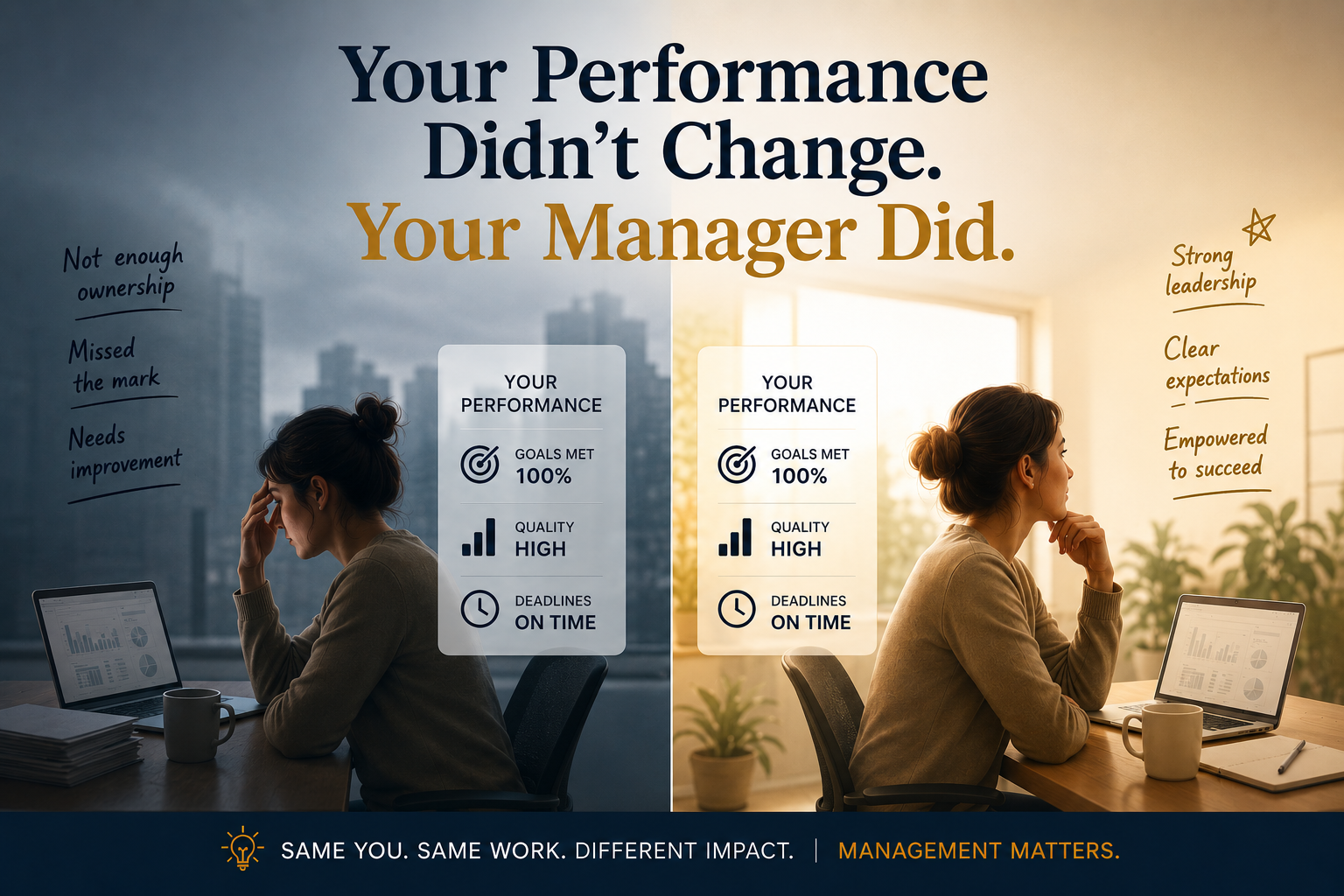
You have a track record of strong reviews. Year after year, the same rating. Solid. Sometimes exceptional. Then a new manager arrives, and suddenly you are rated differently.
Nothing about your work changed. The person evaluating it did.
This is one of the most disorienting experiences in professional life, and one of the most common. I see it regularly, across organisations of every size, in every sector. And what I also notice is how rarely people know what to do with it.
Most respond in one of two ways. They fight the rating, investing significant energy in proving that the assessment is wrong. Or they absorb it quietly, wondering whether they have somehow changed without noticing. Both responses put the manager in control of the narrative.
There is a third path.
What the rating is actually telling you
A performance rating is not an objective measure of your value. It is one person's assessment, at one moment in time, filtered through their priorities, their communication style, and sometimes the budget available for top ratings in any given cycle.
That does not make it irrelevant. A poor rating has real consequences — for your bonus, your progression, your reputation inside the organisation. But it does mean you should understand what is actually driving it before you decide how to respond.
Sometimes a new manager has a genuinely different standard. Sometimes there is a mismatch in working style that can be bridged with effort. Sometimes the organisation itself has shifted, and the new manager is a signal of that shift. And sometimes the environment has simply become one that no longer fits you.
The first step is working out which situation you are actually in.
Before the system makes the decision for you
If you wait long enough without acting, the organisation will eventually decide on your behalf. You will be placed on a Performance Improvement Plan. At that point the dynamic shifts entirely. You are responding to a formal process, on a timeline you did not set, with a predetermined structure.
What most people do not realise is how much agency they have before that moment arrives.
If you have received a rating that surprised you, or one that feels inconsistent with your history, that is the moment to have a direct conversation with your manager. Not to challenge the rating. To understand it.
"I want to understand what success looks like for you in this role, and where you see the gap between that and where I am now."
That is not a passive question. It is information gathering. And it gives you what you need to make a real decision about what comes next.
What your choices actually are
Once you understand the gap as your manager sees it, you have genuine options.
You can choose to close it. If the gap is real, the manager is credible, and the organisation is one you want to stay in, you now have the information you need to change course.
You can choose to challenge it formally. If you believe the assessment is unfair, most organisations have a process for that. This path has a cost. It takes significant energy, it changes your relationship with your manager, and the outcome is not guaranteed. It is sometimes the right choice. Go in with open eyes.
Or you can choose to leave. Not reactively, not in anger, but as a conscious decision about where you want to invest the next chapter of your career.
That last option is the one most people feel least permission to consider. Leaving can feel like losing. But staying in an environment where you do not feel valued, where you spend energy managing a perception problem rather than doing the work you are good at, carries a cost too. A slower one, but a real one.
The agency window
There is a period between the moment you receive a rating that concerns you and the moment the organisation formalises its concern about you. That window is where your choices are widest.
Inside it, conversations are still exploratory. You can gather information without committing to a course of action. You can assess whether you want to invest in repairing the relationship, or whether your energy is better directed elsewhere.
Once you are on a PIP, the window narrows sharply. The organisation is now in motion. You are in a reactive position.
The people I have worked with who navigated this well did one thing differently from those who found it hardest. They acted early, and they were clear about what outcome they were working towards.
The question worth sitting with
Strip out the pride, the frustration, and the understandable desire to be seen as right. The question underneath is simpler.
Is this still an environment where you can do your best work, and where your contribution will be recognised for what it is?
If yes, you have a path. If no, that is worth knowing. And knowing it before the decision is made for you is the difference between leaving on your terms and leaving on theirs.
If this resonated with you, I'd love to continue the conversation.
Get in Touch